
Garage Conversion ADU: What It Costs, What the Rules Are, and When It Beats Building New

ADU Builder editorial – Sacramento, CA
A garage conversion ADU typically runs $150 to $260 per square foot in ballpark planning terms – well under the $250 to $400 per square foot you would spend building a detached ADU from scratch. The reason is simple: the building already exists, bought and paid for, from slab to roof. California law is on your side too. ADUs are legal on single-family lots statewide and your city cannot ban them. A compliant application gets ministerial review, which means no public hearing and no neighbor veto. In many garage-conversion cases the city cannot even require you to replace the parking you lose. But the number that matters is yours, not the average. Your electrical panel and your finish level move the price more than square footage does. This guide gives you the real numbers, plus the honest cases where converting your garage is the wrong move.
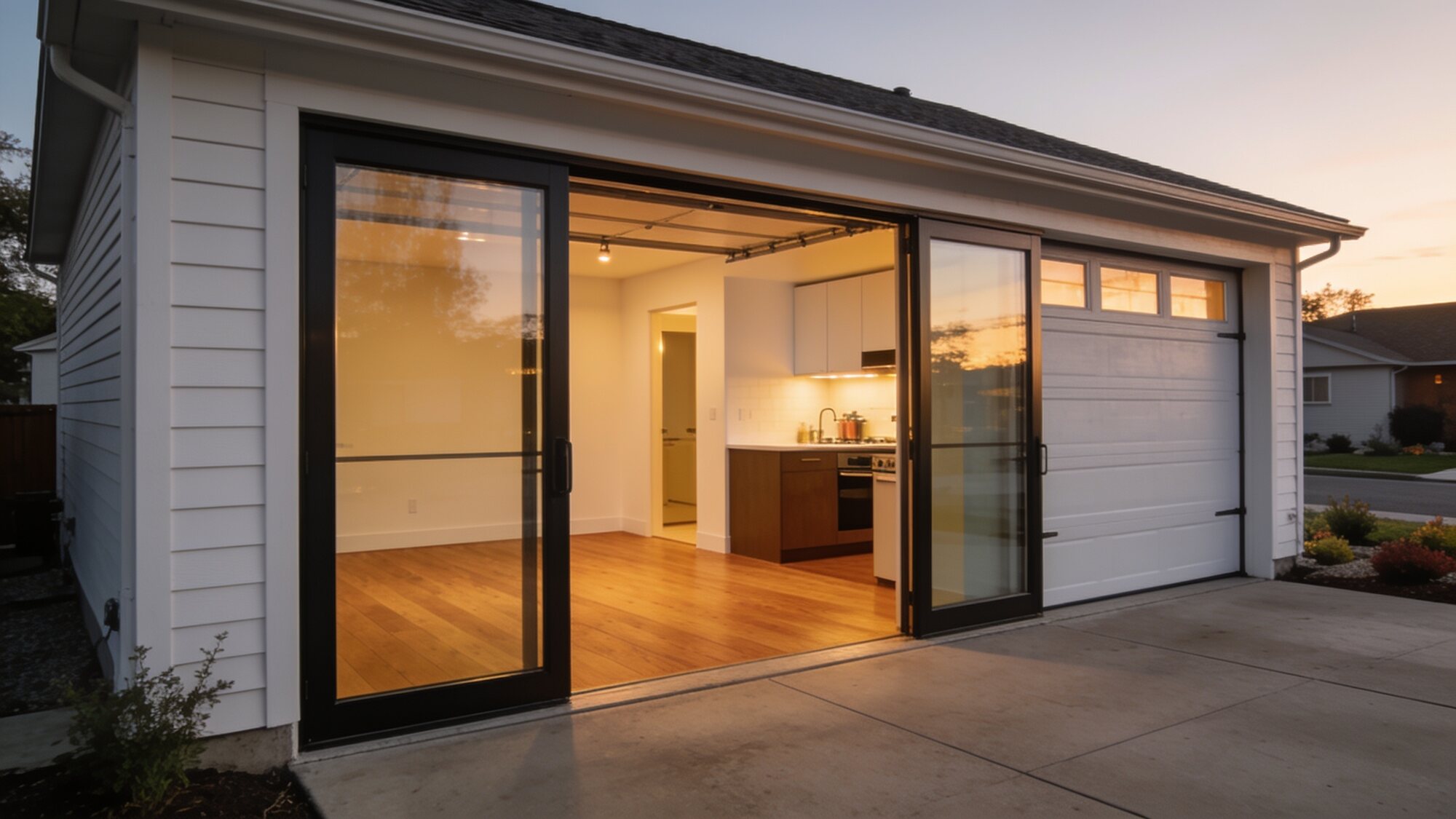 Concept rendering – illustrative, not a completed project.
What does a garage conversion ADU actually cost?
Plan around $150 to $260 per square foot. That’s a ballpark planning range, not a quote. Nobody can quote your project without standing on your slab, and you should be suspicious of anyone who tries.
Run the math on a 400 square foot two-car garage and you land somewhere between roughly $60,000 and $104,000. Yes, the spread is wide. It’s wide because site conditions move the number far more than square footage does, and we would rather hand you an honest range than a tight number that grows later.
Now set that next to building new. A detached ADU runs roughly $250 to $400 per square foot in the same ballpark terms, so a 600 square foot detached unit lands around $150,000 to $240,000. Same lot and the same laws, but a very different check.
That gap is the entire reason garage conversions exist as a category. The full picture of ADU pricing, and how people actually pay for it, lives on our ADU cost and financing page. The nuts and bolts of conversion projects are on our garage conversion ADU page.
Why is converting so much cheaper than building new?
Because the expensive bones already exist. The slab was poured years ago and the roof already keeps the rain out. You are not constructing a building from bare dirt. You are finishing one that is already standing and already paid for.
That head start is real money. Slab work and framing eat a big slice of any new build’s budget, and a conversion skips both. What you are paying for instead is the interior: insulation, drywall, plumbing, a kitchen, a bath, and the systems that turn a garage into a legal dwelling.
Before you celebrate, though, hear the part most articles skip. The per-square-foot range is not where your risk lives. Your risk lives in a short list of line items that have nothing to do with how big the garage is:
- Electrical panel capacity. An ADU adds real load. If your main panel has no room left, an upgrade goes into the budget before the first wall is framed.
- Utility connections. How far water and sewer have to travel matters. Trench length is priced by the foot, not by good intentions.
- Slope and drainage. A garage that sits low or sheds water the wrong way needs correction before it becomes living space.
- Septic capacity. On septic instead of sewer? The system has to handle another household before the county says yes.
- Finish level. Builder-grade and custom can sit tens of thousands of dollars apart on the identical floor plan.
Notice what’s missing from that list: the size of your garage. This is exactly why our estimates are written after a free on-site visit, no obligation. Guessing is how budgets grow, and growing budgets are how homeowners learn to hate contractors.
What are the rules for a garage conversion ADU in California?
Friendlier than you think. That is state law talking, not contractor optimism, and every word of it can be verified at the California Department of Housing and Community Development.
Here is what the statewide framework gives you:
- ADUs are allowed on single-family lots statewide. Your city cannot ban them.
- A compliant application gets ministerial review. No public hearing. No planning commission voting on your backyard.
- Agencies face statutory timelines for review, so a complete application cannot sit in a drawer indefinitely.
- Owner-occupancy cannot be required for standard ADUs under current law.
- Your HOA cannot flatly prohibit an ADU.
- And the one that matters most for garage projects: in many garage-conversion cases, the city’s power to demand replacement parking is limited.
That last point deserves a second look, because it kills the objection we hear most. Homeowners assume that losing the garage means the city will force a new covered spot somewhere on the lot. In many conversion cases, state law says otherwise.
The rules still have to be applied to your specific lot in your specific jurisdiction. That’s why permits and zoning sit inside our design-build scope instead of on your weekend to-do list.
Garage conversion vs. detached ADU vs. JADU: which one fits?
All ballpark planning ranges below. Site conditions move every one of these numbers.
| Garage conversion | Detached ADU | JADU | |
|---|---|---|---|
| Cost per sq ft (ballpark) | $150 – $260 | $250 – $400 | $100 – $200 |
| What you reuse | The existing slab and shell | Nothing; everything is built new | Space inside your existing home |
| Size | Fixed by your garage’s footprint | Typically 400 – 1,200 sq ft, your choice | Capped at 500 sq ft by state law |
| Best fit | Lowest cost for a separate unit | Maximum space and privacy | Tightest budgets, family close by |
If the table nudges you toward building new, our detached ADU construction page covers that path. If even the conversion budget feels heavy, a Junior ADU converts up to 500 square feet inside your existing house at roughly $100 to $200 per square foot. And here is a detail most homeowners never hear: under state law, many lots may have both a JADU and a full ADU. Two legal units, one single-family lot.
What could a converted garage rent for?
Sacramento-region ballparks, and treat them exactly that way. Verify against live local listings before you bet a dollar on any of these bands:
- Around 400 sq ft: roughly $1,400 to $1,900 a month
- Around 600 sq ft: roughly $1,700 to $2,300
- Around 800 sq ft: roughly $2,000 to $2,700
- Around 1,200 sq ft: roughly $2,400 to $3,200
A garage conversion usually lives at the smaller end of that scale because you are bound to the existing footprint. The build cost lives at the smaller end too. Put the two ballparks side by side and run your own payback math with your own numbers. We are not going to invent a return-on-investment figure to dazzle you at 2 a.m. The live listings in your zip code are a better analyst than any blog post, ours included.
When does building new beat converting the garage?
Here is the section a garage-conversion contractor is not supposed to write. We would rather lose a conversion job today than build you something you resent in five years.
Build new instead when:
- You need more room than the footprint allows. A conversion is locked to the garage you already have. Detached units typically run 400 to 1,200 square feet, and you pick the number.
- You actually use the garage. If cars, tools, holiday boxes, or a half-finished project live in there, losing that space carries a daily cost no spreadsheet captures.
- The structure isn’t worth reusing. The conversion discount comes from reusing the slab and shell. If either needs major correction, the discount shrinks with every fix, and sometimes it shrinks enough that new construction wins.
- You want top-of-market rent. The higher rent bands belong to bigger units, and bigger means building new.
- You want distance between households. An attached conversion shares a wall with your house. A detached unit shares a backyard. Those are different lives.
Still sorting out which path is yours? Our accessory dwelling unit guide walks the whole decision from the first question.
Do you need a permit, and what happens if you skip it?
Yes, you need a permit. Design and permitting come before construction, every time, no exceptions worth discussing.
How long that stage takes depends on your jurisdiction’s workload, so any contractor promising an exact permit date is guessing out loud. What state law does give you is a clock: agencies face statutory review timelines, so a complete application keeps moving.
The sequence itself never changes: design first, then permits, then construction. Plans drawn before approval are not a delay. They are the reason the build passes inspection instead of stalling halfway through.
As for the unpermitted route, let us save you the suspense. An unpermitted garage unit turns into a resale problem. Disclosure forms ask about it. Inspectors find it. The money saved up front tends to come back out of the sale price later, with stress added on top. If you already own an unpermitted conversion, that’s fixable, and it’s a conversation worth having before the house goes on the market, not after.
You have now read every ballpark we can honestly give you from a distance. The real number comes off your own lot, and it comes in writing. ADU Builder is a Sacramento design-build contractor serving roughly 200 miles around the city. The on-site estimate is free and written, and nobody vanishes after the handshake. Request your free ADU quote or call (916) 432-0333.
Garage conversion ADU questions, answered straight
How much does a garage conversion ADU cost?
Plan around $150 to $260 per square foot as a ballpark range – roughly $60,000 to $104,000 for a 400 square foot garage. Site conditions like electrical panel capacity and finish level move the number more than size does, which is why we only give written estimates after a free on-site visit.
Will the city make me replace the parking I lose?
In many garage-conversion cases, state law limits a city’s power to require replacement parking. The exact answer depends on your lot and your jurisdiction, and it gets confirmed during permitting. The state’s ADU rules are published by the California Department of Housing and Community Development.
Can my HOA block a garage conversion ADU?
No. Under California law, HOAs cannot flatly prohibit ADUs. Reasonable conditions can exist, but a blanket ban does not hold up under current state law.
Do I need a permit to convert my garage?
Yes. Design and permits come before construction, and an unpermitted unit creates real resale problems later. The good news: a compliant application gets ministerial review with no public hearing, and agencies face statutory timelines for processing it.
How long does a garage conversion take?
Timelines vary with your jurisdiction’s permit workload, so the honest answer is that it depends on where you live. State law does put statutory review timelines on agencies, and design plus permitting always happens before the build starts.
What rent could a converted garage bring in?
Sacramento-region ballparks run about $1,400 to $1,900 a month near 400 square feet and $1,700 to $2,300 near 600. Treat those as ballparks and verify against live listings in your own zip code before you make any decisions.
Get real numbers for your lot
Ballparks are for reading. Your number comes from your lot – and the site visit is free.
Free ADU Estimate
Tell us about your lot and we will call you with real numbers.