
The All-Electric ADU: Why Skipping the Gas Line Saves Sacramento Homeowners Twice

ADU Builder editorial – Sacramento, CA
An all electric ADU is a second home on your lot with no gas line and no gas service: heat pumps handle the hot water and the heating and cooling, and an induction cooktop handles the cooking. Skipping gas can save you twice. The first saving is on the build itself, because there is no gas trench to dig and one utility connection instead of two. The second is SMUD money. The utility pays builders an incentive for qualifying all-electric ADUs, and it offers rebates of up to $4,000 on a heat pump water heater and up to $3,000 on heat pump HVAC if you switch your main house off gas. Neither amount is a reason to build. Both are real, though, and the builder incentive only reaches you if your builder enrolls and puts it in your written price. Below: what SMUD actually pays and who gets the check, plus what you give up and what we check on your lot first.
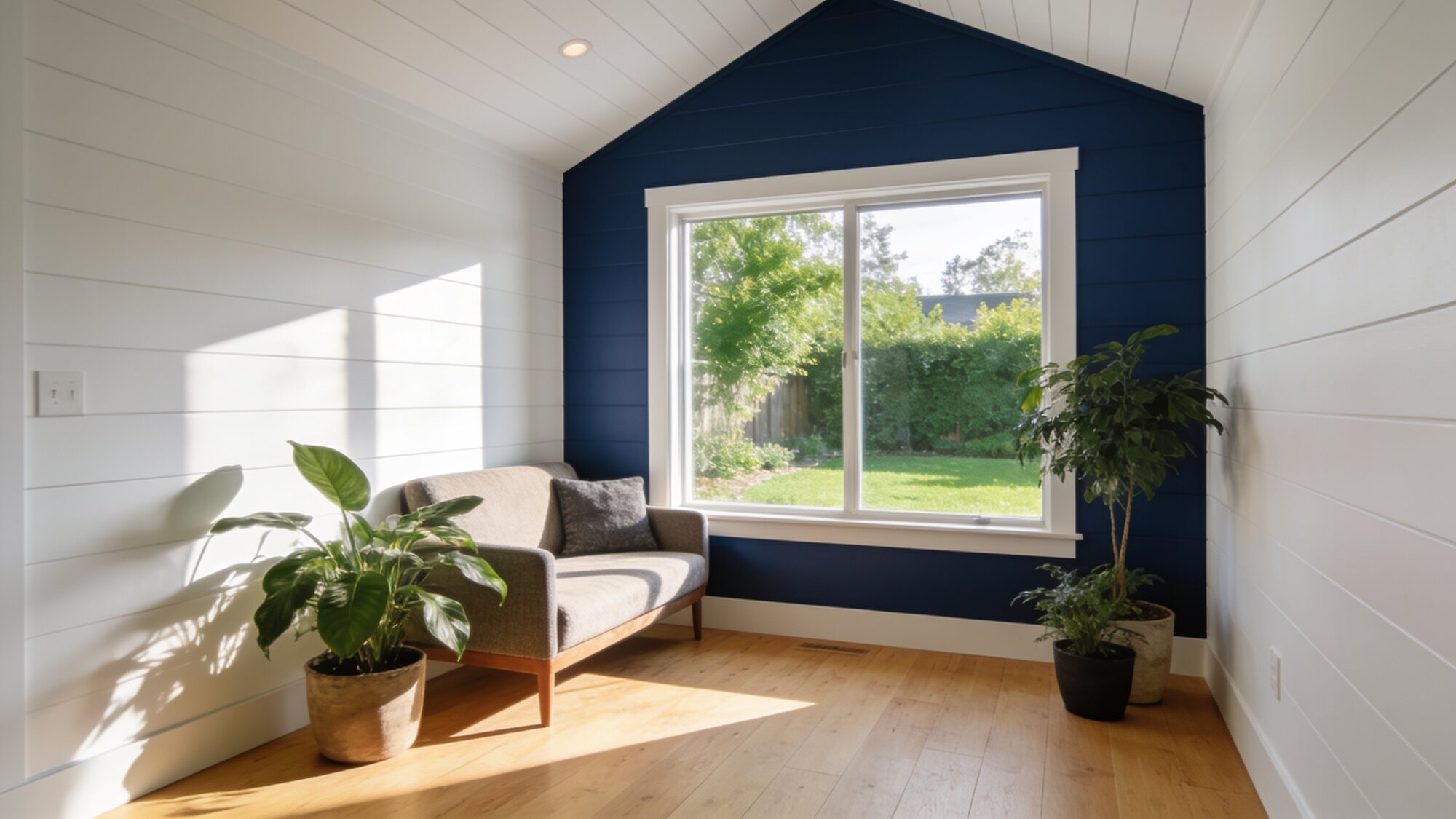 Concept rendering – illustrative, not a completed project.
What exactly is an all electric ADU?
It is a second home on your property that never touches natural gas. No gas line runs to it. No gas service feeds it. A heat pump water heater makes the hot water, a heat pump heats and cools the rooms, and an induction cooktop does the cooking. One utility, not two.
People hear “all electric” and picture a stripped-down place. It is not one. Your floor plan and your finishes are still your decisions. The difference is what powers the appliances.
You will hear plenty of big claims about this online, so let us stay with what can be checked. The City of Sacramento plans this way itself: its free shelf-ready ADU plans are all-electric designs. When the city hands homeowners ready-made drawings, those drawings have no gas line on them. That does not make all-electric right for your lot. It does tell you this is a normal way to build here, not an experiment.
And the basics have not changed. California allows ADUs statewide and reviews them ministerially, which means the city checks your plans against set rules instead of ruling on whether it likes the idea. Our permits and zoning guide shows how that plays out on a real lot.
Where does the first saving come from?
The first saving is plain subtraction. Every piece of gas infrastructure you do not build is a cost that never reaches your invoice.
Start with the trench. A gas ADU needs a gas line run to it, and that means digging. An all-electric ADU has no gas trench. Next comes the meter. A gas unit may need its own gas meter or a line extension from the existing service, and yours needs neither. Then the connection itself: a gas ADU has two utilities to hook up, and yours has one.
Then the equipment. A heat pump handles both heating and cooling in a single unit, so you are buying one system where a gas build often has two.
We are not putting a dollar figure on any of that, and you should be wary of anyone who does without standing on your lot. The size of the saving depends on your site: where gas service sits compared with where your unit goes, and what is in the ground between. A gas main far from your backyard makes the skipped trench worth more. One right beside it makes it worth less. That is why our estimate is written, and why it starts with a free site visit.
What does SMUD actually pay, and who gets the check?
SMUD, Sacramento’s electric utility, runs a builder incentive for all-electric ADUs. In 2026 and 2027 it is $1,400 per unit, or $1,750 with an affordable-housing bonus. Read that sentence again, because it hides the catch: the incentive is paid to the builder, not to you.
To qualify, the unit has to meet SMUD’s requirements:
- No gas line and no gas service to the unit
- A heat pump for water heating, and a heat pump for space heating and cooling
- An induction cooktop
- An eligible smart thermostat
Builders enroll through TRC. So here is what that means for you. A builder who never enrolls leaves the money unclaimed. A builder who enrolls and never mentions it simply keeps it. Neither is how we work. We enroll and we design the unit so it qualifies. Then we put the incentive into your written numbers, so you see it on paper instead of taking our word for it.
Is the SMUD incentive a good reason to go all electric?
No, and you should hear that from us now rather than discover it later. A $1,400 incentive is modest next to a six-figure build. It is a bonus. If flame cooking matters to you or to your future tenant, no incentive should talk you out of it.
The better reason is the simpler build: one utility connection instead of two, and no gas work in the ground. Decide on that. Treat SMUD’s money as a pleasant extra on top, and hold your builder to the part that matters, which is design that actually qualifies and a price that shows the incentive in writing.
Gas ADU or all electric ADU: how do they compare?
Here is the side-by-side, nothing dressed up.
| Item | ADU with gas | All-electric ADU |
|---|---|---|
| Gas trench and line | Needed to reach the unit | None |
| Gas meter or line extension | May be needed | None |
| Utility connections | Two: electric and gas | One: electric |
| Heating and cooling | Can mean two separate systems | One heat pump does both |
| Hot water | Gas or electric | Heat pump water heater |
| Cooktop | Gas flame, or electric if you prefer | Induction |
| Electrical panel | Checked at the site visit | Matters more – may need an upgrade, checked at the site visit |
| SMUD builder incentive | Not eligible | $1,400 per unit in 2026 and 2027 ($1,750 with affordable-housing bonus), paid to the builder |
| Best fit | You or your tenant will not give up flame cooking | You want the simpler build and are fine with induction |
Notice what is missing: a total. Site conditions rule the final number on every lot, and the table only shows you which line items exist.
What about your main house? That is the second saving.
This part gets overlooked. In February 2026 SMUD raised its rebates for electrifying an existing home. When you switch from gas, you can get up to $4,000 for a heat pump water heater and up to $3,000 for heat pump HVAC.
Think about the timing. Your ADU job puts an electrician on your property and a trench in your yard. If your main house has an aging gas water heater or furnace, doing that upgrade while the crew is already there is cheaper than calling them back next year.
Two honest notes. First, those rebates say “up to,” so your amount depends on the equipment and on SMUD’s terms. Read them on SMUD’s page before you buy anything, not after. Second, a heat pump water heater or HVAC system in the main house adds electrical load, so the panel question covers the whole property, not only the ADU.
What are the honest downsides?
Flame cooking comes first. If you love cooking over a flame, induction is a change. It is a fast, good change, but it is a change, and you should know that before you commit. If you or your future tenant will not give it up, build a gas unit and skip the incentive. That is a fair choice, and we will build it for you.
Panel capacity comes next. Everything in an all-electric ADU runs on electricity, so your electrical panel carries more of the load. Depending on what you have now, an all-electric ADU may need a panel upgrade. We check that during the free site visit, before you see a price, so it lands in the written number instead of surprising you halfway through the job.
How can you tell whether your builder is doing this right?
Do not take anyone’s word on this, ours included. Ask for four things on paper before you sign. First, the design: that the unit meets every SMUD requirement listed above, from the thermostat to the cooktop. Second, the enrollment: that your builder is signed up through TRC. Third, the price: that the incentive shows up as a line you can see. Fourth, the panel: that someone has looked at yours and written down what they found. A builder who bristles at any of those four has told you what you needed to know.
What will it cost, and what could it rent for?
Treat these as planning ranges, not quotes. A detached ADU in this region runs roughly $250-400 per square foot, and a garage conversion runs roughly $150-260 per square foot. Our pages on detached ADU construction and garage conversions show what pushes a number up or down, and ADU cost and financing covers how homeowners pay for it. Going all-electric changes some line items inside those ranges. It does not rewrite the whole picture.
On the income side, planning ranges for the Sacramento region are about $1,400-1,900 a month for a roughly 400 square foot unit and about $2,000-2,700 for a roughly 800 square foot unit. Verify those against live listings in your own neighborhood before you build a plan around them.
What happens when you call us?
We are a Sacramento design-build ADU contractor, which means the team that designs your unit is the team that builds it. That matters here, because an all-electric ADU works best when the design and the panel are decided together on day one instead of patched together later. Our design-build process is built around exactly that.
Step one is a free on-site visit. We walk your lot, look at your panel and see where your utilities sit. Then you get a written estimate. If all-electric fits, the SMUD builder incentive is in the numbers and we handle the TRC enrollment. If gas fits your life better, we will tell you that too.
Call us at (916) 432-0333 or request your free estimate. Bring your questions. We would rather answer them now than have you wonder later.
Questions homeowners ask about all-electric ADUs
Does the SMUD all-electric ADU incentive come to me or to my builder?
It goes to the builder. SMUD pays $1,400 per unit in 2026 and 2027, or $1,750 with an affordable-housing bonus, and builders enroll through TRC. What matters to you is whether your builder enrolls and shows the incentive in your written price. We do both, and we design the unit to qualify.
Will an all-electric ADU need an electrical panel upgrade?
It may. Everything in the unit runs on electricity, so panel capacity matters. There is no honest way to answer that over the phone, because it depends on the panel you have now and what it already carries. We check it during the free site visit, before you see a price, and it goes into your written estimate.
Can I have a gas stove in an all-electric ADU?
No. SMUD’s requirements call for no gas line and no gas service to the unit, plus an induction cooktop. If you love cooking over a flame, induction is a change – a fast, good one, but a change. If flame is non-negotiable for you or your tenant, build a gas ADU and give up the incentive. That is a fair trade, and we will tell you so.
What SMUD rebates can I get for my main house?
SMUD raised its main-house electrification rebates in February 2026: up to $4,000 for a heat pump water heater and up to $3,000 for heat pump HVAC when you switch from gas. The amounts are “up to,” so check SMUD’s current terms before you buy. If your ADU job already has an electrician on your property, ask us whether it makes sense to line up the main-house upgrade at the same time.
Is an all electric ADU cheaper to build?
Some line items disappear: the gas trench, and the gas meter or line extension. You also get one utility connection instead of two, and one heat pump handles both heating and cooling. How much that adds up to depends on your site, so we do not quote a number from a distance. General planning ranges are $250-400 per square foot for a detached ADU and $150-260 for a garage conversion. Your real figure comes from the free on-site visit and a written estimate.
Get real numbers for your lot
Ballparks are for reading. Your number comes from your lot – and the site visit is free.
Free ADU Estimate
Tell us about your lot and we will call you with real numbers.