
JADU vs ADU: The Six-Figure Difference Nobody Explains Properly

ADU Builder editorial – Sacramento, CA
Here is the short answer. A JADU (Junior ADU) is a unit of up to 500 square feet built inside the walls of your existing house, and in ballpark planning terms it runs roughly $100-$200 per square foot. An ADU is a complete separate dwelling – detached, attached, or converted from your garage – usually 400 to 1,200 square feet, with detached construction running roughly $250-$400 per square foot. That means a JADU can land between $50,000 and $100,000, while a 600 sq ft detached ADU lands around $150,000-$240,000. Almost the same word, and the gap in the check you write can run six figures. The detached unit rents for more and lives like a real house; the JADU costs less because your walls and roof already exist. Under California law, many lots can have both. Here is how to pick without guessing.
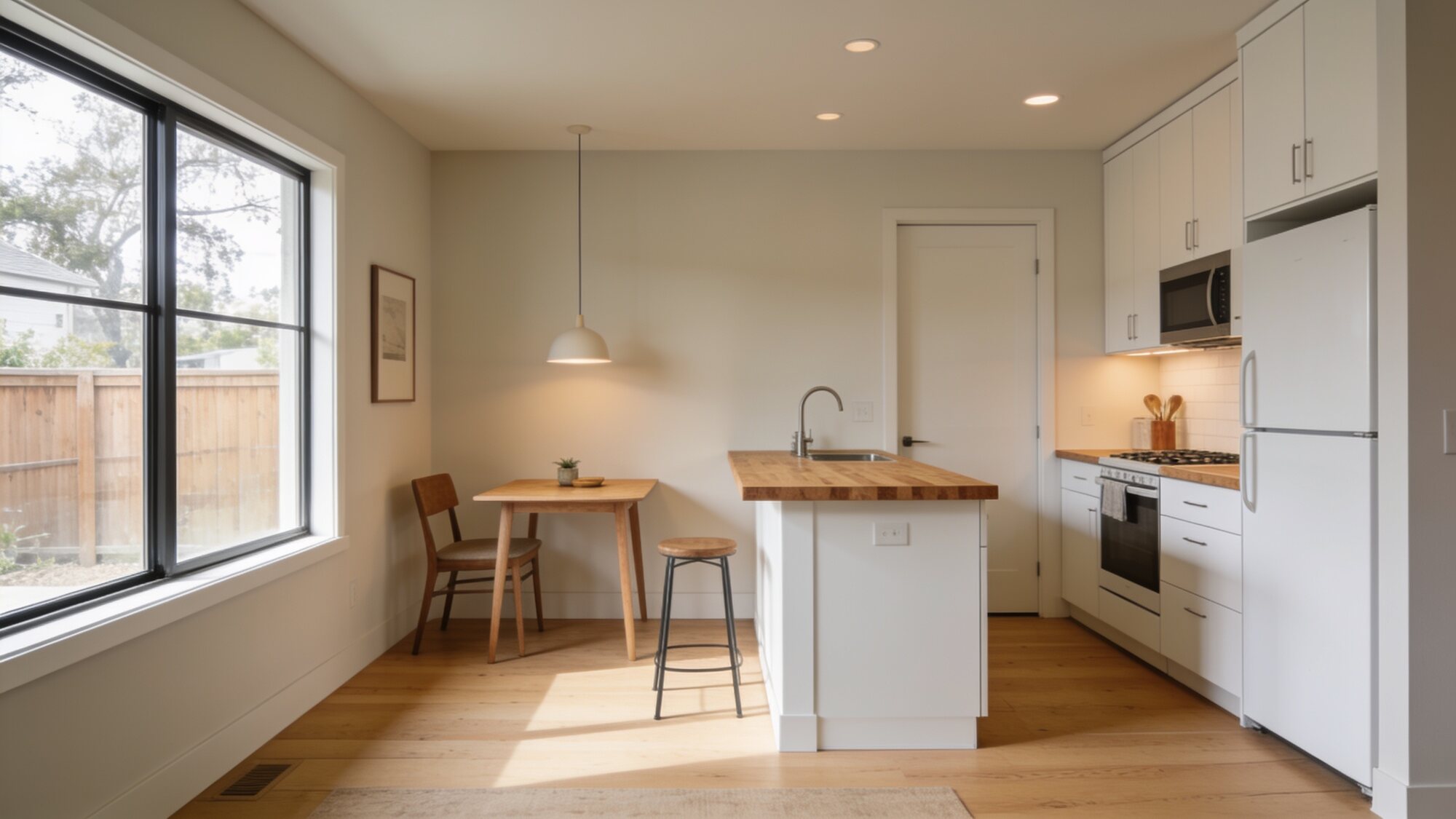 Concept rendering – illustrative, not a completed project.
What is a JADU, really?
A Junior ADU is capped at 500 square feet, and it must live inside your existing home. That is the whole trick. You are not pouring a foundation or framing a roof. You are converting space you already own – a spare bedroom and the bath beside it, say – into a small rental with its own entrance.
Because the expensive parts of the building already exist, the ballpark planning range for a JADU runs roughly $100-$200 per square foot. Multiply that against the 500 sq ft cap and the whole project can land between $50,000 and $100,000. Those are planning numbers, not quotes. Your plumbing layout and panel capacity will move them, sometimes by a lot.
If you have never heard of a JADU, you are not behind. Most homeowners who find our junior ADU service page arrive believing the choice is a backyard building or nothing. Often, the cheaper answer was inside the house all along.
What makes something a full ADU?
An ADU is a complete, self-contained dwelling on your property, with its own kitchen and its own front door. Under California’s statewide ADU law, ADUs are allowed on single-family lots across the state, and your city cannot ban them.
The construction route sets the price. A detached ADU is new construction in your yard, roughly $250-$400 per square foot in ballpark planning terms. A garage conversion reuses the existing slab and shell, which is exactly why it runs cheaper, roughly $150-$260 per square foot. Typical builds land between 400 and 1,200 square feet.
Run the numbers on a 600 sq ft detached unit and you get roughly $150,000-$240,000. That is the figure that makes people set the calculator down at 2am. It is also the figure that buys a real standalone house that rents like one.
Why has nobody told you about JADUs?
Follow the incentives. A detached ADU is a bigger contract and a bigger loan, and most of the people in the chain earn more when you build bigger. So the marketing machine talks about backyard homes and stays quiet about the 500 sq ft unit hiding in your floor plan.
We build both, so we do not care which one you pick. We care that you pick it on purpose. A homeowner who spends $150,000-$240,000 on a detached unit when a JADU in the $50,000-$100,000 range would have solved the actual problem is not a success story. Neither is the reverse: squeezing a JADU into the house when the lot could carry a detached unit and the bigger rent band that comes with it.
Where does the six-figure difference actually come from?
The gap does not come from the floor plan. It comes from what already exists before the first hammer swings. A JADU borrows your home’s entire structure, and a garage conversion borrows the slab and shell. A detached ADU borrows nothing, so every foot of it is new construction, and every foot of it shows up on the invoice.
| Option | Typical size | Ballpark cost per sq ft | Ballpark project range |
|---|---|---|---|
| JADU (inside your existing home) | Up to 500 sq ft | $100 – $200 | $50,000 – $100,000 |
| Garage conversion ADU | Your garage’s existing footprint | $150 – $260 | $60,000 – $104,000 at 400 sq ft |
| Detached ADU | 400 – 1,200 sq ft | $250 – $400 | $150,000 – $240,000 at 600 sq ft |
Read every cell as a ballpark planning range, not a quote. What moves your real number is mostly invisible from the curb: trench length to your utilities, the slope of your lot, septic capacity if you are on septic, whether your electrical panel needs an upgrade, and the finish level you choose. Those items swing cost harder than square footage does. Two identical floor plans on two different lots can finish tens of thousands of dollars apart.
Any contractor who hands you a firm price over the phone is guessing. Our ADU cost and financing guide shows where the dollars actually go.
What will each one rent for?
Here are Sacramento-region ballpark monthly rent bands. They are reading numbers, not underwriting numbers. Verify them against live local listings before you borrow a dime.
- Around 400 sq ft: roughly $1,400 – $1,900 per month
- Around 600 sq ft: roughly $1,700 – $2,300 per month
- Around 800 sq ft: roughly $2,000 – $2,700 per month
- Around 1,200 sq ft: roughly $2,400 – $3,200 per month
Notice what the bands do. A JADU is capped at 500 square feet, so it lives near the bottom of that ladder. A detached ADU can climb the whole thing. That is the honest trade: the JADU costs a fraction to build and collects a smaller check every month, while the detached unit costs six figures and earns like a small house.
One more honesty check. A JADU shares your address and your building, and some tenants will pay a premium for a standalone unit but will not consider a rental inside somebody’s house. The bands above are size-based ballparks; the market decides what your specific unit is worth. Live listings are your truth serum.
So do the 2am arithmetic both ways. Divide the build range by the monthly rent band. Look at the months. The small project with the small rent sometimes pays itself back faster than the big project with the big rent. Sometimes it does not. Your lot decides, not the internet.
Which one should you build?
Nobody can answer that from a blog post, including us. But the pattern is consistent enough to put in writing:
- Lean JADU if your budget stops short of six figures and you are comfortable with a tenant inside your home’s footprint.
- Lean garage conversion if you want a fully separate ADU at the lowest per-foot cost. State law limits parking-replacement requirements in many garage-conversion cases, so the old “you will have to rebuild the garage” objection often no longer applies.
- Lean detached if you want the biggest rent band and real distance between your back door and your tenant’s.
- Lean nothing yet if you have not checked live rents or had anyone qualified walk your lot. Ballparks are for reading, not borrowing.
Whichever way you lean, permits and design come before construction. Every time. Our permits and zoning page walks through the sequence so nothing surprises you in month three.
Can you have both a JADU and an ADU?
On many single-family lots in California, yes. State law allows many lots to hold both a JADU and an ADU, which is how some homeowners end up with two rent checks from one property.
The statewide law helps you in other quiet ways. Compliant applications get ministerial review, which means no public hearing and no neighbor at a microphone deciding your project’s fate. Agencies face statutory review timelines. Your HOA cannot flatly prohibit an ADU. And for standard ADUs, owner-occupancy cannot be required under current law. JADUs carry their own wrinkles on some of these points, so verify before you plan around any single rule. The authoritative summary lives at the California HCD ADU page.
If you are eyeing the both-units play, sequencing matters, and so does your panel, because two new kitchens draw more power than one. This is design-build territory: the people drawing your plans and the people building them should be the same company, so the price does not mutate between the two.
How long will approval take? Timelines vary with jurisdiction workload, and anyone promising you an exact approval date before anything is submitted is selling, not informing.
The hard truths before you spend a dollar
Unpermitted units cause resale problems. The conversion your neighbor “just did” without paperwork becomes the buyer’s leverage and the seller’s headache the day the house hits the market. If a contractor shrugs at permits, walk.
The other truth: your real cost does not live in this article. It lives in your trench length, your slope, your panel, and your soil. A blog table cannot see any of that, and neither can a contractor on the phone.
That is why we do free on-site written estimates with no obligation. You get a number in writing from someone who stood on your lot, not a range from someone who read your zip code. ADU Builder is a Sacramento design-build contractor serving homeowners within about 200 miles, and we would rather tell you a JADU is all your situation justifies than sell you a detached unit you do not need.
Start with a free ADU quote or call (916) 432-0333. Bring your 2am math. We will bring the parts of it you cannot Google.
JADU vs ADU: quick answers
What is the main difference between a JADU and an ADU?
A JADU is capped at 500 square feet and must be built inside your existing home, which keeps costs down because the structure already exists. An ADU is a complete separate dwelling, typically 400 to 1,200 square feet, built new in the yard or converted from a garage, and it rents more like a standalone house.
How much cheaper is a JADU than a detached ADU?
In ballpark planning terms, JADUs run roughly $100-$200 per square foot while detached ADUs run roughly $250-$400. That puts a maxed-out 500 sq ft JADU around $50,000-$100,000, while a 600 sq ft detached unit lands roughly $150,000-$240,000. Site conditions move every one of these numbers, which is why estimates belong in writing after a site visit.
Can I build both a JADU and an ADU on the same lot?
Under California’s statewide ADU law, many single-family lots may have both a JADU and an ADU. Compliant applications get ministerial review with no public hearing. Confirm what your specific lot allows before planning; the state’s official guidance is published by California HCD.
Will a JADU rent for as much as a detached ADU?
Usually not, because rent tracks size and separateness. Sacramento-region ballparks: units around 400 sq ft rent roughly $1,400-$1,900 per month, while units around 800 sq ft rent roughly $2,000-$2,700. A JADU caps at 500 sq ft, so it sits near the lower bands. Always verify against live local listings.
Do I need a permit for a JADU?
Yes. Permits and design come before construction for both JADUs and ADUs, and unpermitted units cause real resale problems. The good news: compliant applications get non-discretionary review with no public hearing, and agencies face statutory review timelines.
Get real numbers for your lot
Ballparks are for reading. Your number comes from your lot – and the site visit is free.
Free ADU Estimate
Tell us about your lot and we will call you with real numbers.