
Can I Build an ADU on My Property? The 6 Checks That Decide It

ADU Builder editorial – Sacramento, CA
Short answer: if you own a single-family home in California, you can almost certainly build an ADU. State law says local agencies cannot ban ADUs on single-family lots, and a compliant application gets ministerial (non-discretionary) review with no public hearing. Even your HOA cannot flatly prohibit one. The real question is not whether you can build – it is what your lot allows and what it will cost. Six checks decide that: zoning, space, utilities, budget, HOA paperwork, and your permit path. As a ballpark planning range, a detached unit runs roughly $250-400 per square foot, so a 600 sq ft unit lands around $150,000-$240,000 depending on site conditions. Most Sacramento-area homeowners clear all six checks without drama. The ones who get burned are the ones who skip the checks and find out mid-build. This article walks you through each one before you spend a dollar.
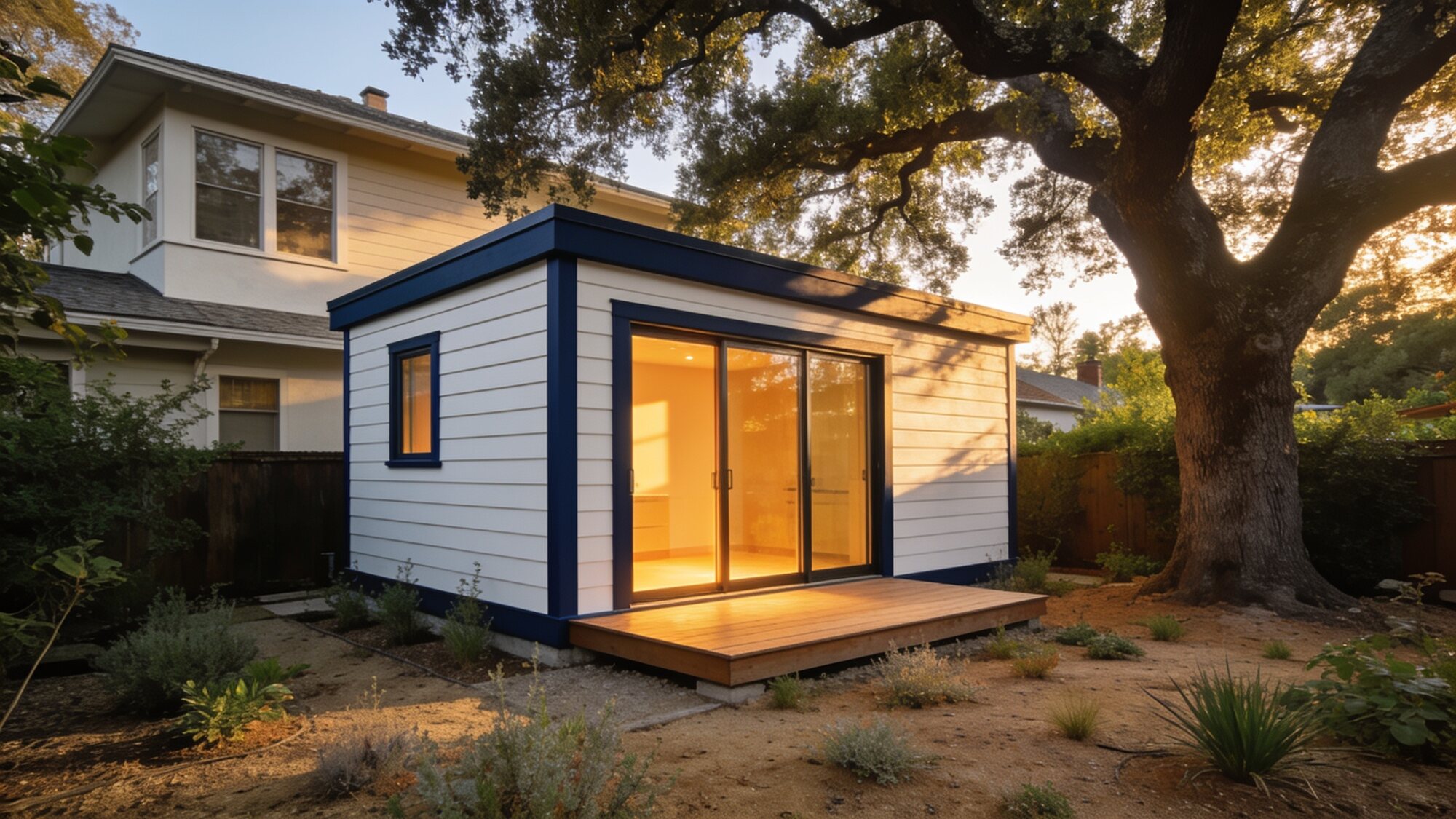 Concept rendering – illustrative, not a completed project.
You are here because you own a lot and you have a rough idea. You probably also have a healthy suspicion of anyone promising easy answers. Good. Suspicion is the right tool for this purchase. Below are the six checks that actually decide whether an ADU happens on your property – the same six we run on every site visit before we talk numbers.
Check 1: Does state law cover your lot? (Almost certainly, yes)
Here is what most homeowners do not know while they are doing 2 a.m. math on a second unit: California already settled this fight for you. Statewide ADU law allows accessory dwelling units on single-family lots across the state, and local agencies cannot ban them. Not your city. Not your county.
It gets better. A compliant application receives ministerial review. That is a legal term for “checklist, not opinion.” No public hearing. No neighbor at a podium deciding your project’s fate. If your plans meet the standards, the agency approves them – and agencies face statutory review timelines, so a complete application cannot sit in a drawer indefinitely.
Two more protections worth knowing. Owner-occupancy cannot be required for standard ADUs under current law, which means you can rent out both the ADU and the main house. And none of this is our marketing – the state publishes the rules at the California HCD ADU page. Read them yourself.
What state law does not do is design your project. Local standards still shape where the unit sits and how big it can be. That is check two. For the full rulebook in plain English, our ADU permits and zoning guide goes deeper.
Check 2: Where would the unit actually go?
Walk your lot before you call anyone. Most ADUs land in one of three spots: open yard space, your existing garage, or inside the walls of your current house. Each is a different project with a different price tag. Typical builds run 400 to 1,200 sq ft.
| ADU type | Where it goes | Size | Ballpark planning range |
|---|---|---|---|
| Detached ADU | New structure in the yard | Typically 400-1,200 sq ft | Roughly $250-400 per sq ft |
| Garage conversion | Inside your existing garage | Whatever the garage gives you | Roughly $150-260 per sq ft |
| Junior ADU (JADU) | Inside the existing home | Capped at 500 sq ft | Roughly $100-200 per sq ft |
Those are ballpark planning ranges, not quotes. Site conditions move the number, and on some lots they move it a lot. More on that in check three.
Why is a garage conversion cheaper? A boring reason: the structure is already standing, so you are not paying to build it. You are paying to turn storage into living space.
And here is the detail almost nobody knows: under state law, many lots may have both a JADU and an ADU. One property, two rentable units. If your lot qualifies, that changes your math in a hurry.
Which type is right for you is a money-and-purpose question, not a fashion question. Housing an aging parent points one direction; maximizing rent points another. Hold your answer loosely until you see what your lot allows.
Check 3: Can your utilities handle a second home?
Here is the truth that never makes the glossy brochure: square footage is not what moves your price most. Utility trench length, slope, septic capacity, electrical panel upgrades, and finish level drive cost more than the size of the unit does.
Think about what a second home actually needs. Every utility the new unit uses has to travel from your existing connections to wherever it sits. The farther the unit sits from those connections, the longer the trench, and trenching is money. A yard with slope needs engineering that a flat yard does not.
Your electrical panel matters too. Plenty of older Sacramento-area homes run panels that were never sized to feed a second kitchen and a second HVAC system. If the panel needs an upgrade, that goes in the budget before drywall ever does. Same with septic: if you are not on sewer, your tank’s capacity gets a vote.
None of this kills a project. It moves the number. Which is exactly why we do free on-site written estimates instead of quoting your lot blind over the phone – a price that ignores your trench line is a price that grows later.
Check 4: Does the 2 a.m. math actually work?
You have already run some version of this math. Cost on one side, rent on the other, and the question of whether the spread is worth years of your attention. Load both sides with honest numbers.
Cost side: as a ballpark planning range, a 600 sq ft detached unit lands roughly $150,000-$240,000. A garage conversion of similar size usually comes in under that because the structure exists. A JADU comes in lower still.
Rent side, in Sacramento-region ballpark monthly bands – verify these against live local listings before you decide anything:
- Around 400 sq ft: $1,400-$1,900 per month
- Around 600 sq ft: $1,700-$2,300 per month
- Around 800 sq ft: $2,000-$2,700 per month
- Around 1,200 sq ft: $2,400-$3,200 per month
Now do your own division. Take the middle of the rent band and multiply by twelve. Hold that against the build cost for your unit type. Nobody can do that arithmetic for you, and you should not trust anyone who does it too eagerly.
Two warnings. First, rent bands are ballparks – your street and your finish level matter, so check what comparable units actually rent for this month, not what a blog claimed last year. Second, resist building the biggest unit your lot allows just because bigger rents for more. Cost per square foot and rent per square foot do not climb at the same rate. For financing routes and a fuller breakdown, see ADU cost and financing.
Check 5: Will your HOA or parking rules block you?
Homeowners in HOA neighborhoods often assume the association holds a veto. It does not. Under California law, HOAs cannot flatly prohibit ADUs. An association can apply reasonable rules, but “no ADUs here” is not one of them.
Parking is the other imagined wall. Converting the garage means losing covered parking, and many homeowners assume the city will force them to rebuild it. In many garage-conversion cases, parking replacement is limited under state law. Confirm the specifics for your jurisdiction, but do not let a parking assumption kill the idea before you have checked.
One honest caution on timing: permits and design come before construction, always. Agencies face statutory review timelines, but real-world speed still varies by jurisdiction workload. Build calendar patience into your plan.
Check 6: Are you willing to build it permitted?
This is the check where we lose a few readers, and that is fine. Somewhere along the way, someone will suggest converting the garage quietly. No permits, no inspectors. The pitch is always the same: everybody does it.
What everybody does not tell you: unpermitted units cause resale problems. When you sell, the unit either gets disclosed or discovered, and either way it complicates the deal. Some of the hardest conversations in this business happen with owners trying to sell a house that has an unpermitted conversion sitting behind it.
The irony is that California made the legal route easier than it has ever been, with ministerial review and statutory timelines written into state law. Doing it right has never been this straightforward, which makes doing it wrong a strange bet. We build permitted, full stop. If you want the quiet route, we are not your builder.
So, can you build an ADU on your property?
Run yourself through the list one more time:
- You own a single-family lot in California – state law is on your side.
- You have a spot picked out – open yard or existing structure.
- You know your utility picture, or you are ready to have it checked.
- The rent-versus-cost math holds up against live local listings.
- Your HOA cannot flatly stop you, and now you know it.
- You are building it permitted, on the record.
If you nodded through most of that list, the answer to the title question is yes – and the next step costs you nothing.
We are ADU Builder, a Sacramento-based design-build contractor serving roughly 200 miles around Sacramento. We walk your lot with you and put a written estimate in your hand. Free, no obligation, and the number reflects your trench lines and your panel – not a brochure average. Start with a free ADU quote or call (916) 432-0333. Still in research mode? Our full accessory dwelling unit guide is the long version of everything above.
Questions homeowners ask before the first call
Can my city say no to an ADU on my single-family lot?
Not with a flat ban. California law allows ADUs on single-family lots statewide, and local agencies cannot prohibit them. A compliant application gets ministerial review – a checklist decision with no public hearing. Local standards still control details like placement and size, so your design has to comply, but the answer to “can I build at all” is set by state law, not by city hall’s mood.
Can my HOA stop me from building an ADU?
No. Under California law, HOAs cannot flatly prohibit ADUs. An association may apply reasonable rules, but a blanket ban is not enforceable. If your HOA has told you otherwise, point them to the state HCD’s published ADU guidance.
Do I have to live on the property to rent out my ADU?
For standard ADUs, no. Owner-occupancy cannot be required under current California law, which means you can rent out the ADU whether or not you live in the main house.
How much does it cost to build an ADU?
As ballpark planning ranges, not quotes: detached ADUs run roughly $250-400 per sq ft, garage conversions roughly $150-260, and JADUs roughly $100-200. A 600 sq ft detached unit lands around $150,000-$240,000. Site conditions such as trench length, slope, panel capacity, and finish level move these numbers, which is why we put real figures in a free on-site written estimate instead.
Can I have both a JADU and a full ADU on the same lot?
Many lots may have both under state law. A JADU is capped at 500 sq ft and sits inside the existing home, while the ADU can be a detached or converted unit. Two units on one lot changes the rental math considerably, so it is worth checking whether your lot qualifies.
What happens if I build an ADU without permits?
Unpermitted units cause resale problems. The unit gets disclosed or discovered during a sale, and it complicates the appraisal and the buyer’s financing. With ministerial review and statutory timelines now built into state law, the permitted route is more straightforward than it has ever been. We only build permitted.
Get real numbers for your lot
Ballparks are for reading. Your number comes from your lot – and the site visit is free.
Free ADU Estimate
Tell us about your lot and we will call you with real numbers.